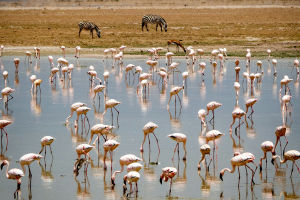
Hello Lykkers! Today we are stepping into one of the most unusual natural stories on Earth. We are going to explore how flamingos live, breed, and raise their young in extreme lake environments that seem almost impossible for life.
Yet, they not only survive but also thrive. Their journey shows us how nature builds clever survival systems in the most unexpected places.
Living in Extreme Natural Lakes
Flamingos often choose habitats that most animals cannot tolerate. We usually find them around shallow alkaline lakes in warm regions, where mineral levels are extremely high. These lakes are shaped by natural geological forces and long periods of evaporation.
Even though the water conditions appear harsh, these lakes are rich in microscopic life. Tiny organisms such as algae grow in large amounts, becoming the main food source for flamingos. Because of this reliable food supply, flamingos gather here in huge numbers during breeding seasons.
We can see that what looks like a difficult environment for many creatures becomes a perfect feeding ground for flamingos. Their survival is closely connected to this unique ecological balance.
The Fascinating Group Dance
When breeding season arrives, flamingos create one of the most impressive group displays in the animal world. Thousands of birds gather together, forming large colonies that move in synchronized patterns.
We observe them walking slowly in groups, turning their heads in different directions, and stretching their wings in smooth, coordinated motions. This is not just a performance. It is a key part of how flamingos form strong pair bonds.
Instead of relying on competition, flamingos depend on rhythm, timing, and group harmony. The energy of the flock creates a lively atmosphere where pairs gradually form through shared movement and visual signals. This natural process helps ensure stable partnerships for breeding.
Building Homes on Mineral Islands
After pairs are formed, flamingos begin an extraordinary nesting process. They do not build nests in trees or hidden ground areas. Instead, they construct nests on raised mineral formations that appear when lake water levels drop and evaporation increases.
These formations become small island-like structures made of hardened mineral deposits. Flamingos carefully shape shallow nests on top of these surfaces using available materials. Each nest is designed to keep the egg slightly elevated above the surrounding area.
At first glance, this environment may seem too harsh. The surface can become very warm under direct sunlight, and conditions may change quickly. However, flamingo parents work together to protect their eggs. They take turns standing over the nest, using their bodies to provide shade and temperature control.
This shared responsibility helps ensure that the eggs develop safely despite the challenging environment.
The First Days of Life
After around one month of incubation, flamingo chicks begin to hatch. This moment marks the beginning of a new life, but survival challenges continue immediately.
The nesting areas attract attention from other birds that may attempt to take advantage of the eggs or newly hatched chicks. Flamingo parents try to protect their young, but the environment is naturally competitive, and risks are always present.
Because of these conditions, flamingo families do not stay long in one place. After the chicks grow stronger, parents guide them away from the nesting islands and move toward safer lake regions nearby.
These new areas offer more space and resources, but young flamingos must still learn how to survive in a changing environment.
Learning to Survive in the Wild
As flamingo chicks grow, they begin an important learning journey. We see them practicing movement, balance, and coordination every day. Each small action helps strengthen their wings and body control.
They learn by following the group, observing adults, and repeating movements. If they struggle or fall, they quickly try again. This constant practice builds both physical strength and confidence.
Living in groups also provides protection. Staying close to others reduces risk and helps young flamingos understand migration patterns, feeding areas, and environmental changes.
Nature does not provide an easy path for them. Instead, every stage of growth requires adaptation, awareness, and steady improvement.
Final Thoughts with Lykkers
Lykkers, the life of flamingos teaches us something powerful about survival and adaptation. From dancing in large groups to raising chicks on mineral islands, every stage of their journey is shaped by teamwork and resilience.
Their story reminds us that even in extreme environments, life can find balance and beauty. Growth often comes through challenge, and progress is built step by step through experience.
Thank you for exploring this fascinating natural world with us.
Flamingo: 99 Days From Egg To Survivor — Born on a Mud Island | Wildlife Documentary
Video by BBA Wild Kingdom